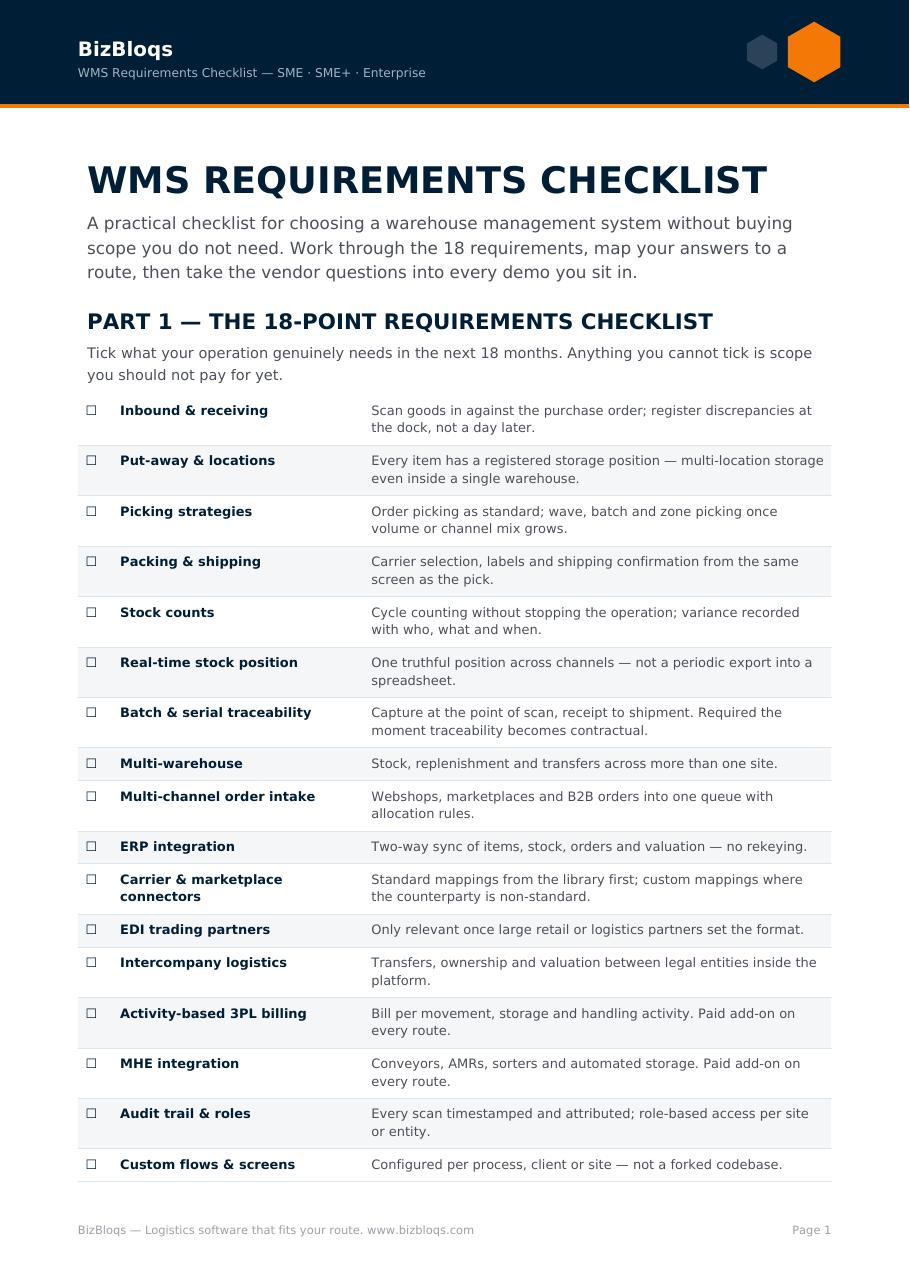
The warehouse management process flow runs in one direction: goods are received, put away, stored and replenished, then picked, packed and dispatched, with returns and counting running alongside. At every step the aim is the same: the record in the system matches what is on the shelf.
Warehouse management is the discipline of controlling four things at once — stock, space, labour and process — from the moment goods arrive until the moment they leave. Done well it is invisible: orders go out complete and on time, counts match, and nobody is walking the aisles looking for a pallet. Done badly it does not fail loudly; it leaks quietly through errors, overtime and write-offs.
Where the discipline meets software, the system that directs the work is a warehouse management system.
The warehouse process flow, step by step
- Receiving. Verifying inbound goods against the purchase order or ASN, recording quantities, batches and condition, and resolving discrepancies at the dock rather than at month-end.
- Putaway. Deciding where each item belongs. Rule-based putaway uses velocity, size, temperature, batch and hazard class instead of leaving the choice to whoever is on shift.
- Storage and slotting. Organising locations so fast movers sit close to dispatch and slow movers do not occupy prime space. Slotting is the cheapest capacity you will ever buy.
- Replenishment. Topping up pick faces from bulk before they run dry, so pickers never stop.
- Order picking. The most labour-intensive process in the building, and therefore where most of the cost and most of the improvement sit.
- Packing and dispatch. Carton selection, carrier allocation, labels and documents, and the final verification that what is in the box matches the order.
- Returns. Grading, restocking or scrapping, and getting sellable goods back into availability quickly.
- Counting. Cycle counting by location and velocity, instead of an annual shutdown that only tells you how wrong you were.
The KPIs that actually matter
Most warehouses measure too many things and act on none of them. Five numbers carry the weight:
- Inventory accuracy. Counted stock versus system stock, by location. Manual operations typically sit at 85–95%; scan-driven operations sit above 99%.
- Order accuracy (pick accuracy). Lines shipped correctly as a share of lines shipped. This is the number that shows up in customer complaints.
- On-time dispatch. Orders leaving within the promised cut-off.
- Lines picked per hour. Your labour productivity baseline, and the one that responds most directly to routing and process change.
- Dock-to-stock time. How long goods sit in receiving before they are sellable. A slow figure here quietly creates phantom stockouts.
Measure them weekly, by shift, and look at the trend rather than the absolute. A stable 96% is a manageable operation; a figure that swings between 91% and 99% is an operation running on individuals.
Four stages of maturity
Paper and memory. Picklists on paper, locations in people's heads, stock reconciled in a spreadsheet. Works until roughly the point where one person can no longer see the whole operation.
ERP stock accounting. Quantities are in the ERP and the finance figures are right, but the ERP does not know where anything physically is and does not direct anyone. The spreadsheet and the whiteboard survive alongside it.
Scan-driven execution. A WMS directs putaway and picking, every movement is scanned, accuracy stabilises above 99%, and a new picker becomes productive in a day. This is where most SMB operations should be, and where the largest single jump in cost per order happens.
Orchestrated operations. Warehouse execution connected to order management, channel availability, carriers and EDI, with mechanisation, run by a warehouse control system, where volume justifies it. Decisions move from reactive to planned.
Warehouse management versus inventory management
Inventory management answers "how much do we own and what should we buy". Warehouse management answers "where is it, who is touching it, and in what order". They are complementary, and confusing them is the most common reason an operation believes an ERP stock module is enough. If your team still keeps a private record of where things really are, you are doing inventory management without warehouse management.
Where software starts to pay
The trigger is rarely size alone. It is usually one of these: SKU count outgrowing memory, a second shift that cannot inherit the first shift's knowledge, batch or expiry obligations, a growing return rate, or the first serious customer claim. At that point the leak is already funded — it is simply being paid in temps, credit notes and write-offs instead of in software.
For the mechanics of what a system actually does, read What Is a Warehouse Management System; for the money, see What Does a WMS Cost; and to model your own numbers, use the ROI calculator. For the free measurement tools referenced throughout, see the warehouse calculators.
Currency and support hours change the picture as much as the licence does. We publish the local cost breakdown for the United Kingdom, the United States, Canada, Singapore and South Africa, each quoted in local currency.