Warehouse picking: where the time goes and what to change first
Warehouse operations and configuration, international ERP implementations, Lean Six Sigma Black Belt, founder of BizBloqs.
This guide is for owners and operations managers of wholesale, e-commerce and manufacturing companies that run their own warehouse — from a handful of pickers up to a few dozen. It shows you where your warehouse hours actually go, and what to change first so that fewer of them are spent walking.
It is not written for fully automated operations, or for companies that have handed fulfilment to a third party; the way of looking at the problem still applies, but the specifics will not. If what you want is to improve warehouse picking speed and accuracy, the short answer is that you will get further by shortening the walk than by asking anyone to walk it faster.
Both of those halves are rules of thumb out of my own years on warehouse floors rather than market figures.
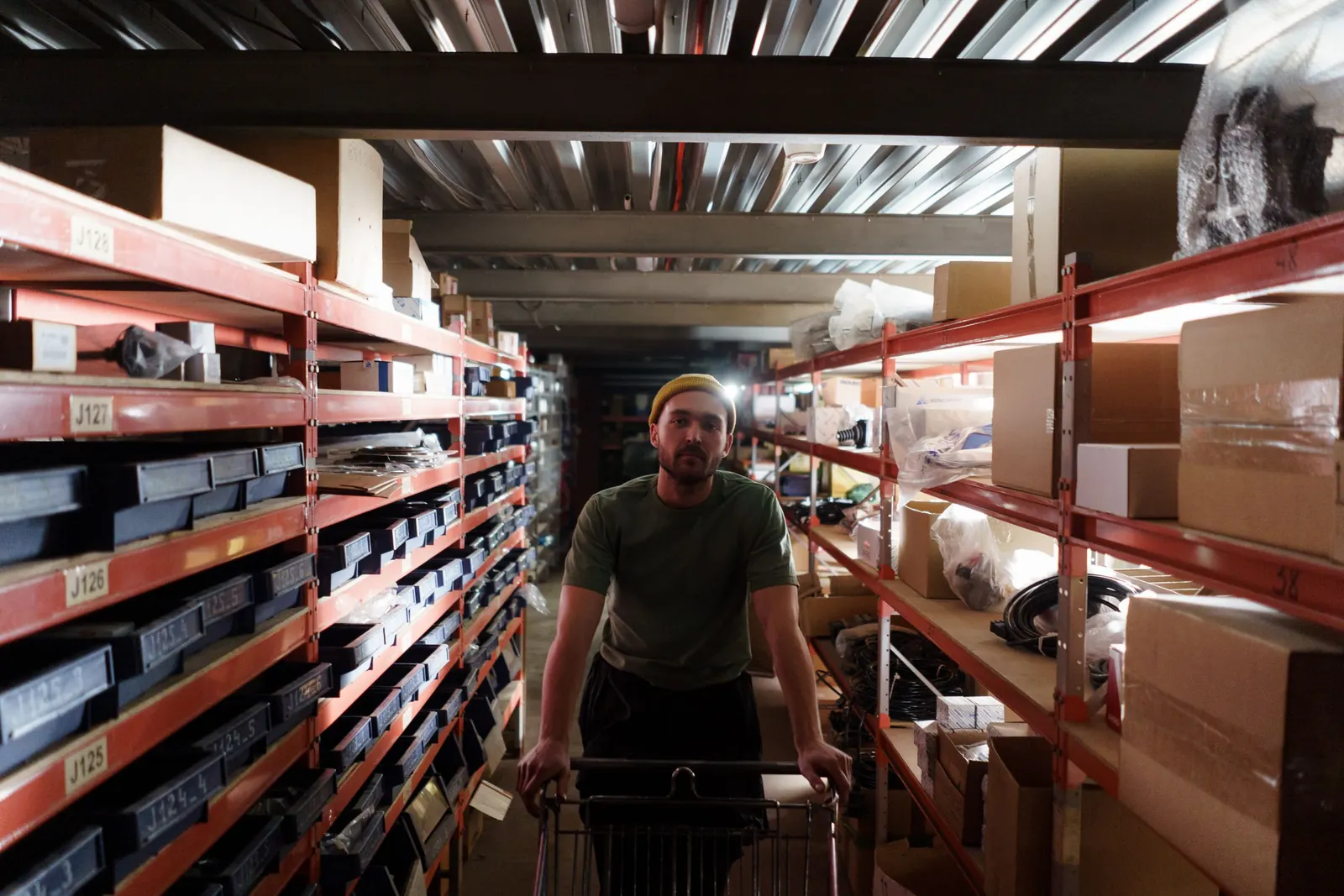
A workout at work
I once spent a morning on the floor of a prospect's warehouse. No racking anywhere: a lot of one kind of stock, stacked where it had ended up. I asked four questions — how many steps do your people walk in a day, how are products located around the building, do you work in zones, and do you store by ABC. Nobody had counted the steps. Products sat where there had been room. No zones, no ABC.
From those four answers one fact followed: every order picker was walking the whole warehouse for every single order. They were doing twenty thousand steps a day. A workout at work — except that the company was paying for it by the hour and getting nothing back for it. By the time we had finished talking, the owner had worked out that he had been running the building that way for fifteen years.
Scroll sideways to see the whole drawing.
Illustration of the kind of building described, not a plan of it.
That building did not need racking. It needed to know where everything was, and to be able to direct a picker to the next location. Zones, ABC storage, picking several orders in one round, a consolidation area where they get sorted: every one of those is a decision rather than a purchase — and not one of them survives on paper. Something has to hold the picture and direct the work.
Most warehouse improvement starts somewhere else entirely. It starts with whatever is annoying people this week — a jammed conveyor, a printer that keeps running out, a supplier who delivers badly stacked pallets. All of it is worth fixing. None of it is where your money is going.
If you want a warehouse to get meaningfully better, you have to put your effort where the hours actually are. In almost every warehouse I have walked through, that is order picking. And inside picking, it is walking.
That single idea is the whole of this guide. Everything below is a way of acting on it, and the four questions I asked that morning are in section 8, for you to ask in your own building.
Where the time really goes
Take all the labour in a warehouse — receiving, putting away, replenishing, picking, packing, dispatch, counting stock — and roughly half of it goes into order picking. The other half is shared between everything else.
Then look inside picking. Roughly half of a picker's time is spent walking. Not reaching, not scanning, not reading a label, not putting something in a box. Walking from one location to the next.
Scroll sideways to see the whole drawing.
About a quarter of all warehouse labour is someone walking.
Put those two together and you get the number that should drive your decisions: about a quarter of all the labour in your warehouse is someone walking. That is usually the single largest activity in the building, and it produces nothing. Nobody pays you for metres walked.
Both of those halves are rules of thumb out of my own years on warehouse floors rather than market figures. Treat them as the order of magnitude to expect, and then measure your own building — which is what the rest of this section is for.
This is why the arithmetic of improvement is so unforgiving. A thirty per cent improvement in something that accounts for five per cent of your hours gives you one and a half per cent. A ten per cent cut in walking gives you two and a half per cent. Two-thirds more, for less effort. Work on the big number first.
A thirty per cent improvement in something that accounts for five per cent of your hours.
A ten per cent cut in walking, for less effort.
Before you change anything, measure. Walk a full shift with a picker, with a stopwatch or just a pedometer. Count the metres, the minutes standing still, and the times they double back for something they passed five minutes earlier. You will learn more in one shift than in a week of reports, and you will have a baseline to judge your changes against.

The foundation
Before any of the rest, the basics have to be in place. You cannot route a picker sensibly through a building where the stock figure is a guess and half the locations have no label. Every improvement in this guide — layout, slotting, how you steer your orders, which picking method you choose — quietly assumes the opposite, which is why this section comes second rather than last.
It is also the least interesting part of the job, and that is exactly why it gets skipped.
Get this right and everything after it compounds. Skip it and every clever thing you try afterwards will underperform, for reasons that will look like bad luck.
The one between the dock and the shelf.
The step most companies skip is the one between the dock and the shelf. Goods get received, counted and booked in — and then put wherever there is space, without anyone telling the system where. The stock exists on paper and on the shelf, but not in the same place. Pickers start searching, stock-outs appear that are not real, and the cycle counts never reconcile. Every scan at the pick face depends on the scan that was skipped at put-away.
Warehouse layout
Can your picker walk round the corner?
Layout is the cheapest lever you have, because it is mostly a decision rather than a purchase. Three things matter more than the rest.
Get rid of dead ends. If an aisle is closed at one end, a picker who needs one article halfway down walks in, picks, turns round and walks back out. You have paid for that distance twice and got one line for it. Open the ends, or cut a cross aisle through the middle of a long block, so every aisle can be walked through rather than entered and abandoned. A cross aisle costs you a handful of locations. It buys you the ability to leave an aisle in the direction you were already heading.
Make aisles wide enough to pass. When two pickers meet in an aisle that only fits one trolley, both of them stop. One reverses. Neither is picking. It feels thrifty to squeeze the aisles and win another row of racking, and in a slow warehouse it is. In a busy one you have bought storage and sold throughput. Decide which of the two you are short of before you set the width.
Run the racking along the length of the building, not across it. This one is counter-intuitive until you draw it. Racking placed along the long axis gives you fewer, longer aisles. Racking placed across the short axis gives you many short aisles — and every extra aisle is two more aisle ends, two more turns, and another decision for the picker about whether this aisle is worth entering. Longer aisles also give you more usable locations for the same floor area, because you lose less space to aisle ends and cross traffic. Straighter routes, more locations, same building.
Scroll sideways to see the whole drawing.
Illustration, not a measurement of a real building.
The drawing on this page shows the same five picks in the same hall, racked both ways: about thirty per cent less walking and five fewer turns when the racking runs along the length. That is an illustration rather than a measurement of your building, but it is the right order of magnitude to expect.
One more thing anchors all of it: where packing and dispatch sit. Every route in the warehouse starts or ends there. If dispatch is in a corner for historical reasons, and your fast movers are at the far end because that is where there was space, you have built a long walk into every single order. Fix that before you fix anything clever.
This section is about the warehouse you already have. If you are fitting out a new building, or deciding on height, column grid and dock count, those are a different set of decisions and part three of this series covers them.
Warehouse slotting
Deciding where each product lives
Once the shape of the building is settled, the next question is which product goes where. This is the part most warehouses have never done deliberately. Products sit where there was room on the day they first arrived.
Fast movers closest to dispatch. Pull your pick frequency per article over the last three months and sort it. You will find a small group of articles carrying a large share of the picks, a middle group, and a long tail that barely moves. Put the first group nearest to packing and dispatch, the middle group behind them, and the tail at the far end or up high. Sorting products into those three groups by how often they are picked is called ABC analysis.
Things ordered together, stored together. Look at which articles keep appearing on the same order. If two products are almost always bought as a pair, storing them at opposite ends of the building means you walk the length of the warehouse on every one of those orders. Put them side by side and that walk disappears.
Heavy first, light last. Order the locations along the picking route so the heavy, sturdy items are collected at the start and the light, crushable ones at the end. The picker builds a stable pallet or carton as they walk, instead of repacking at the bench or writing off damaged stock. This costs nothing to arrange and removes a whole category of problem.
Spread the fast movers out. This is where a naive reading of ABC goes wrong. If you put every single fast mover in one bay next to dispatch, you have built a traffic jam. Four pickers now want the same two metres of aisle at the same time, and they queue. A few extra metres of walking costs far less than two pickers standing still. Spread the fast movers across several faces of the same near zone.
Scroll sideways to see the whole drawing.
Dark should sit near dispatch, but spread wide enough that pickers do not queue.
Give the exceptional articles exceptional treatment. Most assortments have a handful of articles that appear on nearly every order. Those deserve either several pick locations in different parts of the warehouse, so a picker can always grab one without a detour, or the single easiest position in the building — between waist and shoulder height, right at the front, no bending and no reaching. That easy-reach band is sometimes called the golden zone.
And then do it again. What sells changes with the season and with your range. A slotting plan that was right in March is wrong by October. Put a review in the calendar, at least twice a year. Deciding where each product lives, and revisiting it as demand shifts, is the job called slotting.
One caution before you start. Working out the ABC groups is a morning with a spreadsheet. Holding them — keeping the classification current as demand moves, sending a picker to the right one of several locations, telling anyone where an article now lives — is not, and section 7 is about what that takes.
Steer the orders before they reach the floor
The cheapest pick is the one you never have to do. That makes your order intake a warehouse lever, and almost nobody treats it as one.
A customer ordering eight loose pieces creates eight picks, eight confirmations and a packing problem. The same customer ordering one full carton of twelve creates one movement. If the difference in price is small, many customers will take the carton — they simply do not know the option exists, or that it is cheaper for you.
Eight picks, eight confirmations and a packing problem.
One movement.
So tell them. Put a discount on the full-carton quantity. Show the prompt in the webshop or the order portal: order four more and you have a full box, at a better unit price. Set a minimum order value if your small orders are losing money. Consolidate everything one customer orders in a day into one pick and one shipment instead of three.
What you get back is not only less picking. It is less handling, fewer confirmations, fewer chances to pick the wrong thing, less packing material, less damage in transit, and fewer parcels to pay for. One commercial decision quietly removes work from every step downstream of it — and it needs no racking, no system and no floor space. It needs your sales team and your price list.
Order picking methods
And when each one fits
There is no best picking method. There is a method that fits your order profile, and the profile is what you should be looking at: how many lines on a typical order, how much the same articles repeat across different orders, how big the building is, and what deadlines you are picking against.
One order at a time.
The picker takes an order, walks the route, collects every line, hands it over, starts the next. Simple to run and simple to explain, and genuinely the right answer when your orders are large — if an order fills a trolley on its own, there is nothing to gain from combining it with another.Several orders in one round.
Instead of walking the aisles once for every order, one picker collects the items for several orders in a single round, then sorts them into their orders, either on the way round or afterwards. The more orders that contain the same few items, the more walking this saves. That way of working is called batch picking.A picker per area.
Each picker looks after one part of the warehouse and only picks what is stored there. An order moves from zone to zone, or every zone picks its share at the same time and the pieces are brought together afterwards. Nobody walks the whole building for one order, and each picker learns their own patch properly. This suits large buildings and wide assortments, and it is called zone picking.Releasing work in timed blocks.
Rather than sending every order to the pickers the moment it arrives, you release them in timed groups — say at 10:00, 13:00 and 15:30 — and each group is picked and packed together so it is ready before a courier collects. Between releases the team finishes one group and prepares the next. That way of working is called wave picking, and it is the method of choice when your day is shaped by collection times rather than by order volume.Picking per delivery route.
If you deliver with your own vehicles, pick by route rather than by order, and pick the route in reverse drop order: the last customer first, the first customer last. The van is then loaded so that the first delivery is the first thing out of the back doors. A sequencing problem disappears before it reaches the kerb.Picking by article, then dividing up.
If you supply your own shops or a fixed set of branches, it is often faster to pick the total quantity of one article for all destinations in a single visit to that location, then divide the pile across the shops at a sorting bench. One visit per article instead of one visit per article per shop. In Dutch warehouses this is called uitventen.One warning before you choose.
If your profile is genuinely two-peaked — a great many single-line webshop orders and a great many twenty-line wholesale orders — the answer is two processes, not one compromise that serves both badly. Choosing a single method for a two-peaked profile is the commonest mistake in this section.
1Own delivery routes, or own shops?
- Own delivery routesRoute picking per route, in reverse drop order
- Own shops or branchesArticle picking total per article, then divide (uitventen)
- Neither: shipping to customersGo on to question 2.
2Two-peaked profile? Many 1-line AND many 20-line orders
- YesTwo processes. Run the branch below twice, once per peak. No compromise method.
- No, one dominant shapeGo on to question 3.
3How big is a typical order?
- Large: one order fills a trolleySingle order picking
- Small: a few lines per order, many ordersGo on to question 4.
4Do the same articles repeat across orders?
- Yes, a core range sells constantlyBatch picking
- No, a wide assortment, every order differentGo on to question 5.
5Too big for one picker to walk all of it?
- YesZone picking
- NoSingle order picking with an optimised route
Shaped by carrier collection or production cut-off times? Add wave picking on top of whichever method you land on. It combines; it does not compete.
All of these need the foundation in section 2, and something to direct them. See section 7.
These are not exclusive: plenty of warehouses batch-pick inside zones and release the whole thing in waves. Part two of this series sets out every method side by side, including two that sit outside this guide, with the order profile each one suits.
And every one of them rests on two things. The foundation in section 2, because a clever method running on inaccurate stock and unlabelled locations performs worse than one order at a time, the errors now being batched too. And something to group the orders, split the zones and consolidate the pieces afterwards, which is section 7.
The best route needs something that knows where everything is
Layout and slotting give you structure. They make the average walk shorter, and they do it permanently, which is exactly why they are worth the effort.
But they only get you a good average. The best possible route for the order in front of you right now depends on which lines are on it, where those articles happen to be stocked today, which other orders are open at this moment, and who else is already in that aisle. That answer changes every hour. No supervisor with a clipboard can recompute it, and no printed pick list can hold it.
This is also the point that the warehouse at the top of this guide had reached without knowing it. Zones, ABC storage, batch picking and a consolidation area were all available to that owner, and none of them was a purchase. But a zone nobody is directed into is just a line on a floor plan, and an ABC classification nobody maintains is last spring's spreadsheet. Three decisions in particular are beyond doing by hand at any volume: which orders to combine into one round, in what sequence to visit the locations, and which of several locations for the same article to send this particular picker to. Getting those right needs software that holds a live picture of where every article is and what every picker is doing — a warehouse management system, a WMS.
A zone nobody is directed into is just a line on a floor plan, and an ABC classification nobody maintains is last spring's spreadsheet.

System-directed work also takes the knowledge out of the longest-serving picker's head and puts it on a screen.
The gain is not only metres. A warehouse that routes its work properly is a more orderly place to work in. Work arrives in a steady flow instead of a scramble before the carrier comes. Pickers stop hunting for things, stop queueing for the same bay, and stop being blamed for errors that were built into the route. System-directed work also takes the knowledge out of the longest-serving picker's head and puts it on a screen: in our experience a temporary worker on directed work reaches eighty to ninety per cent of the standard pace inside a week. That is not a market figure either, but it is the difference between seasonal staff who work out and seasonal staff who do not.
That last point matters more than the productivity figure. In a labour market where warehouse staff are hard to find and harder to keep, a building that is not frustrating to work in is a commercial asset.
The four questions
These are the four I asked on that floor, in the order I asked them. You can ask them in your own building this morning, and none of them needs a budget or a project.
- How many steps does a picker walk in a day?Walk a full shift with one of them and time the walking separately from the picking. If nobody has ever counted, that is itself the answer.
- How are products located around the warehouse?Ask who decided, and when. If things sit where there was room on the day they arrived, there is a slotting job waiting for you in section 4.
- Do you work in zones?If one picker covers the whole building for one order, section 6 applies to you.
- Do you store by ABC?Pull pick frequency per article for three months, take the top twenty, and go and find them. Note how far each one is from dispatch, and whether they are all crowded into one bay.
If the answers run: nobody has counted, products sit where there was room, no zones and no ABC — then every picker is walking the whole building for every order, and you have found your project.
Three more worth doing in the same week, because the four questions above do not reach them:
Follow one pallet from the dock to the shelf.
Watch whether anyone scans it to a location on the way, or whether it simply goes where there is space. This is the step in section 2 that most often turns out to be missing.Walk your own aisles, looking for dead ends.
Count how many aisles can only be entered and left from the same end. Then stand in the narrowest one and ask whether two people with trolleys could pass each other.Plot your order lines as a distribution, not an average.
Count how many orders have one or two lines, and how many have ten or more. If both ends are heavy you have a two-peaked profile, and section 6 applies to you twice over.
Who wrote this, and why
We build warehouse and order management software, so a guide arguing that picking is worth thinking about carefully is a guide that suits us. Worth knowing as you read it, and worth knowing most in section 7, which argues that zones, ABC storage and batch picking need something behind them to run. They do, and we sell one.
Worth knowing too: this was not written from the software side alone. It comes out of laying out warehouses and setting up the operations that run in them, and out of implementing ERP systems internationally — long enough to have watched a good many owners work out on their own floor what they had been paying for without seeing it.
The author is a certified Lean Six Sigma Black Belt, which is where the insistence on measuring before choosing comes from, and why this guide opens with four questions rather than four recommendations, and why the two figures in section 1 are labelled rules of thumb rather than dressed up as research.