why wms works best inside a strong logistics ecosystem in q2

    Home / Blog / Why WMS Works Best Inside a Strong Logistics Ecosystem in Q2

    Willem ten Asbroek · Published · 1:09 pm

    The hidden problem behind fragmented logistics partnerships

    In Q2, many SMEs believe their biggest logistics challenge is choosing the right warehouse management system. The reality is more uncomfortable. Most operational breakdowns don’t start with poor WMS software. Rather, they start when systems, partners, and workflows fail to agree on responsibility.

    Across Europe, growing manufacturers, wholesalers, and e‑commerce businesses operate increasingly complex stacks. ERP platforms manage finance, WMS tools control warehouse execution, shipping systems handle transport, and partners bring their own tools into the mix. On paper, everything is connected. In daily operations, however, teams still reconcile stock manually, double‑check order statuses, and fix errors long after orders have moved downstream.

    This gap becomes more visible after Q1 peaks. Volumes stabilise, margins tighten, and tolerance for operational noise drops. What once felt “manageable” suddenly becomes risky. Missed updates, unclear ownership, and conflicting data begin eroding trust, internally and with customers. This challenge is unfolding against a demanding market backdrop. Across the Netherlands and wider EU, logistics operations are dealing with sustained e‑commerce growth, structural warehouse labour shortages, and rising expectations for speed and transparency. Recent industry briefings point to persistently high vacancy rates in warehouse roles, while same‑day and next‑day delivery standards are becoming the norm rather than the exception. At the same time, new EU supply‑chain transparency regulations are increasing the pressure on systems to provide reliable, auditable data across partners. Together, these forces expose weaknesses in logistics ecosystems that rely on manual workarounds and loosely defined system ownership. European logistics industry reports, public market updates, and regulatory briefings, 2026 state.

    Where logistics partnerships break down in daily operations

    From an SME’s point of view, ecosystem failures rarely look technical at first. They surface as small inconsistencies that accumulate over time.
    Common daily issues include:
    • Orders moving between systems while statuses don’t align
    • Stock levels differing between ERP, WMS, and carrier tools
    • Operators manually verifying data “just to be safe”
    • Errors appearing only during shipping, invoicing, or returns

    Internally, teams blame integrations or individual partners. In reality, most breakdowns result from unclear ownership across systems. Each platform completes its part, then hands responsibility forward without shared agreement on what “done” actually means. When no system owns the end‑to‑end flow, people fill the gaps. And human glue does not scale in Q2.

    The real cost of manual handovers between systems

    Manual work in logistics rarely looks dramatic. It looks small, repetitive, and temporary until volume exposes it.
    Hidden daily tasks include:
    • Copy‑pasting order references
    • Reconciling stock discrepancies
    • Re‑entering shipping or carrier data
    • Chasing confirmations across tools
    In Q2, these handovers collide with leaner teams and stricter margin control. Manual processes introduce delays, inconsistency, and emotional pressure on operators. Over time, teams lose confidence in system reporting and fall back on spreadsheets or memory. The real cost of manual work isn’t measured only in hours. It’s measured in uncertainty.
    Many logistics ecosystems fail because providers misunderstand what SMEs value most.
    SMEs are not asking for:
    • More integrations
    • More dashboards
    • More overlapping features
    They are asking for:
    • Clear responsibility boundaries
    • Consistent data across systems
    • Fewer decision points for operators
    • Predictable behaviour under pressure

    In practice, dependability matters more than flexibility. SMEs don’t want configurable complexity. They want workflows that function the same way every day.

    Why shared data standards matter more than deep integration

    Integration alone does not create alignment.
    Many logistics environments are deeply integrated but poorly standardised. Data moves freely between systems, yet those systems disagree on its meaning.
    Without shared standards, organisations face:
    • Different definitions of the same order
    • Conflicting SKU availability rules
    • Inconsistent shipment completion statuses
    The result is predictable. Reports are debated instead of trusted. Exceptions remain invisible. Teams compensate manually.
    Healthy ecosystems begin with operational truth:
    • One system of record per process
    • Clear event ownership
    • Consistent data models across tools
    This is not an API problem. It is a workflow governance problem.
    Well‑designed ecosystems feel boring and that’s the point.
    Day‑to‑day, they show clear signals:
    • Tasks move smoothly between systems
    • Operators trust where data comes from
    • Exceptions stand out immediately
    • Reporting matches physical reality
    Under pressure, these ecosystems hold. Errors don’t multiply and systems support each other. Teams focus on execution instead of coordination. A healthy logistics ecosystem removes the need for human glue.
    A warehouse management system rarely operates alone and this is where ecosystem design matters most. In many SME environments, financial platforms and ERP systems define commercial truth, while WMS platforms manage physical execution. When these systems are loosely connected, discrepancies appear quickly: orders move before approvals complete, stock exists in one system but not another, and invoicing lags behind fulfilment.
    BizBloqs has worked extensively alongside Exact, a widely adopted ERP and financial platform in the European SME market. In these environments, the objective is not to blur system roles, but to clarify them. Exact remains the financial system of record, while BizBloqs’ warehouse management system enforces operational execution.
    When responsibility is clearly defined:
    • Inventory and order events stay aligned
    • Financial and physical statuses reflect the same reality
    • Exceptions surface early instead of during audits or disputes

    Rather than integrations that simply push data, this partnership model synchronises workflows, especially during volume fluctuations common in Q2.

    Ecosystems work when responsibility is shared

    The importance of ecosystem design has increased sharply in 2026. Large‑scale investments in automated logistics infrastructure across major European hubs, combined with tightening EU due‑diligence requirements, are raising the baseline for how systems are expected to interact. While enterprise players can absorb complexity with custom automation, SMEs must rely on dependable coordination between warehouse management systems, financial platforms, and logistics partners to remain competitive. In this environment, fragmented responsibility and manual handovers are no longer operational inconveniences.  They are business risks. This is according to Public infrastructure announcements, EU regulatory updates, and logistics market analyses, 2026. Logistics partnerships don’t fail because systems don’t communicate. They fail because responsibility falls between them.
    In Q2, SMEs feel this more sharply. Manual work becomes visible, exceptions multiply, and trust in reporting declines. A warehouse management system alone cannot fix these issues if it operates inside a fragmented ecosystem. The difference between fragile and resilient operations lies in how systems collaborate. When platforms like warehouse management systems, ERP solutions such as Exact, and logistics partners operate with shared standards and clear ownership, workflows stabilise. Execution becomes predictable. Pressure no longer creates chaos.

    For growing SMEs, the goal isn’t more software. It’s fewer handovers, clearer accountability, and ecosystems designed for operational truth, not assumptions. If your teams are compensating for gaps between systems, it’s time to rethink how your ecosystem is designed.

    Discover how BizBloqs supports predictable warehouse execution without adding complexity. See how a connected warehouse ecosystem works.

    Share this post

    Related Posts

    Not sure which solution fits you?

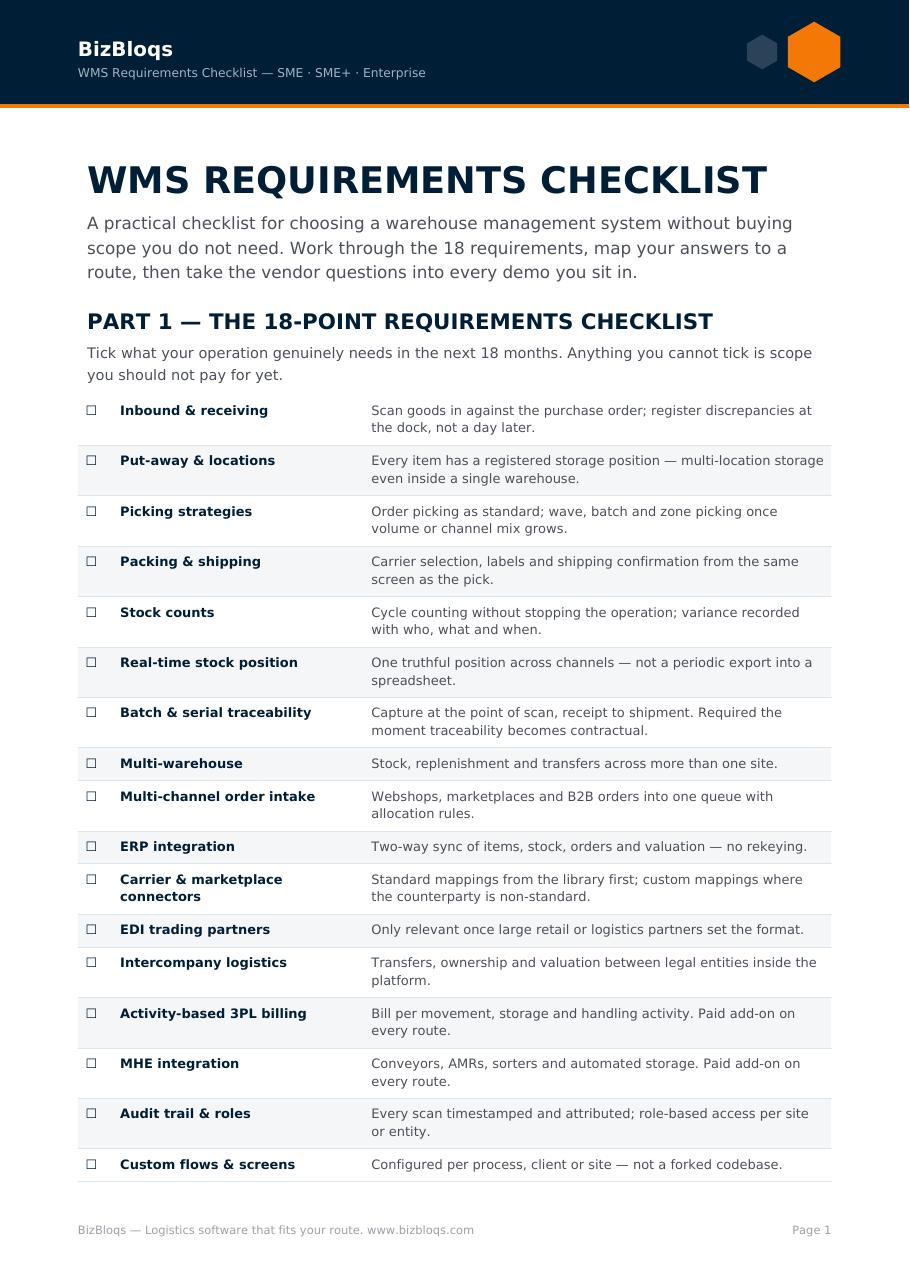
    Work through the 18-point WMS Requirements Checklist and your answers point to SME, SME+ or Enterprise.

    Get the checklist

    Ready to see BizBloqs on your own process?

    Book a demo and we will walk your warehouse and order flow end to end — inbound, storage, picking, shipping, returns — and tell you honestly what BizBloqs would change.