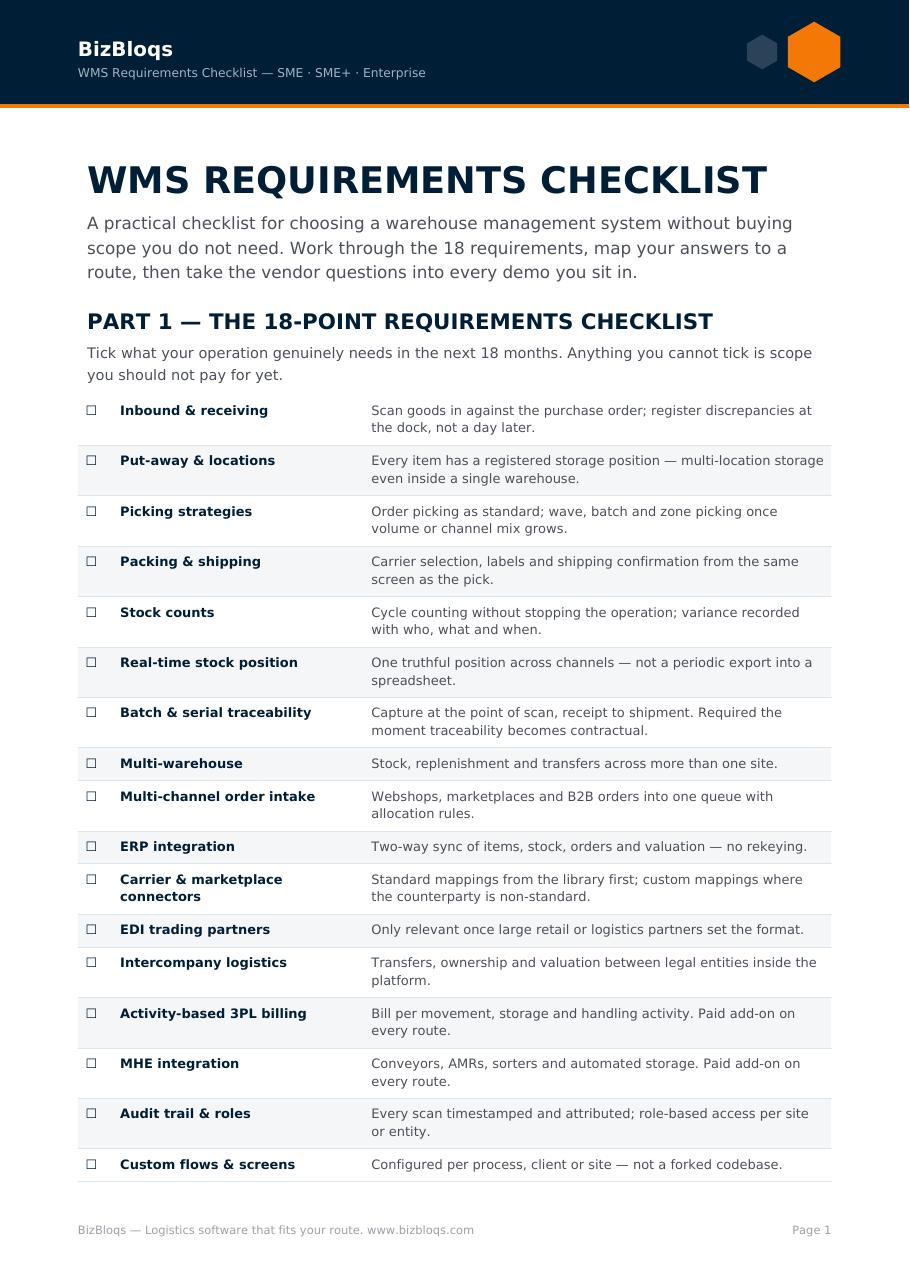
Une sélection se joue à la rédaction, pas à la démonstration.
C'est contre-intuitif, parce que la démonstration est le moment visible : tout le monde est dans la salle, le produit tourne, on prend des notes. Mais ce qui décide du résultat a été fixé des semaines plus tôt, par la façon dont les exigences ont été écrites. Une exigence mal écrite obtient un oui de chaque candidat. Une exigence bien écrite en élimine la moitié.
La règle qui résume tout le reste : une exigence doit être démontrable sur vos propres articles et vos propres commandes. Si on ne peut pas la voir tourner, ce n'est pas une exigence, c'est un souhait.
1. Le périmètre et le contexte
Ce que personne ne peut deviner et qui change tous les chiffres : le nombre de sites, le nombre d'équipes par jour, le volume de commandes et de lignes, le nombre de références, les types de stockage — rack, masse, hauteur, froid, sous douane —, la saisonnalité, et la croissance que vous anticipez à trois ans.
Sans ces éléments, chaque candidat chiffre sur ses propres hypothèses, et les offres deviennent incomparables. Ce n'est pas de la mauvaise foi de leur part : c'est mécanique.
Faites défiler latéralement pour voir toute la figure.
2. Les flux qui doivent tourner
Décrivez des flux, pas des noms de fonctions.
« Gestion des emplacements » n'est pas une exigence. « À la réception, l'emplacement est attribué par le système en fonction de la rotation et de la taille de l'article, et le cariste le reçoit à l'écran » en est une, parce qu'on peut la regarder.
Les flux à couvrir : la réception, le rangement, le réapprovisionnement du front de prélèvement, la préparation dans les méthodes dont vous avez besoin, l'emballage, l'expédition, le comptage, les retours, et les prestations à valeur ajoutée si vous en faites.
3. Les contrôles obligatoires
Lot, numéro de série, date de péremption, blocage qualité, matières dangereuses, obligations d'audit.
Et une distinction à faire explicitement, parce que les éditeurs la chiffrent différemment : ce qui vous est légalement imposé, et ce que vous préférez. Mélanger les deux revient à payer le prix du premier pour obtenir le second.
4. Les intégrations
N'écrivez pas « intégration ERP ». Écrivez, système par système, quels messages doivent passer, dans quel sens, à quelle fréquence, et ce qui se produit quand un message échoue.
Et donnez la version de votre ERP, pas seulement la famille de produit. Deux installations du même produit n'exposent pas les mêmes fonctions, et c'est la version qui détermine le travail réel. Le détail de ce partage est sur wms erp, qui sert de liste de départ pour les messages.
5. Le matériel et le site
Scanners, terminaux, imprimantes, balances, réseau sans fil, équipements automatisés. Et pour chaque ligne, une seule question : qui le fournit.
C'est la section la plus souvent amputée, et elle revient toujours — sous forme d'avenant, au pire moment du projet.
6. Le régime des modifications
C'est la section que presque toutes les consultations oublient, et c'est la plus utile des huit.
Pour chaque écart que vous demanderez par rapport au standard, quatre questions :
- Est-ce de la configuration ou du développement ?
- Qui le fait — vous, l'éditeur, un intégrateur ?
- En combien de temps ?
- Qu'est-ce que cela coûte la deuxième année, quand un client imposera un nouveau bordereau ou qu'un transporteur changera de format ?
C'est cette section qui sépare une plateforme vivable d'une plateforme où chaque changement est un devis. Et c'est la seule qui vous dise quelque chose sur les trois ans à venir plutôt que sur le jour de la mise en service.
7. Les conditions commerciales
Demandez un total sur trois ans, pas un prix mensuel.
À couvrir : la base de facturation, la mise en place, la formation, le support, l'accompagnement du démarrage, la durée d'engagement, et les conditions de sortie — ce que vous récupérez, dans quel format, et à quel prix.
La décomposition d'un devis est détaillée sur coût wms, et la façon de présenter le résultat à un conseil sur roi logistique.
8. La preuve
Trois demandes, et elles sont plus efficaces que vingt pages d'exigences.
Une démonstration sur vos données. Vos articles, vos commandes, vos unités de mesure. Un éditeur qui ne peut pas charger un extrait de votre fichier articles vous dit quelque chose d'important.
Un client de référence joignable, du même secteur et de la même taille, à qui vous pouvez téléphoner sans accompagnateur.
Le nom de la personne qui pilotera la mise en œuvre, avec son découpage en phases. Pas une fonction : un nom. Le déroulé habituel d'un tel projet est sur projet WMS.
Les six questions qui départagent réellement
Si vous n'avez le temps d'en poser que six, posez celles-là.
- Donnez-moi trois écarts que nous ferons nous-mêmes et trois qui passeront par vous, avec le mode de facturation des seconds.
- Combien de clients en production sur notre version exacte d'ERP, et depuis quand ?
- Que coûte un changement la deuxième année — un nouveau transporteur, un nouveau client avec son propre bordereau ?
- Qui nettoie nos données d'articles, et qu'est-ce qui est attendu de nous ?
- Que se passe-t-il quand un message d'intégration échoue — où s'arrête-t-il, qui est averti, comment on le rejoue ?
- Quel est le périmètre minimum de mise en service que vous recommandez, et pourquoi celui-là ?
Un éditeur qui répond aux six par écrit a déjà répondu à l'essentiel de votre consultation.
Les trois choses à retirer du document
La grille de fonctions. Trois cents lignes produisent trois cents cases cochées par chaque candidat. Elle ne retire aucun nom de la liste et coûte des semaines de lecture.
Les questions auxquelles tout le monde répond oui. « Gérez-vous les numéros de lot ? » Oui, tout le monde. La question utile est « montrez-moi un prélèvement bloqué parce que le lot demandé était périmé ».
Tout ce qui n'est pas vérifiable en démonstration. Une exigence qu'on ne peut pas voir tourner ne sera pas vérifiée avant la mise en service, c'est-à-dire trop tard.
Le comparatif WMS détaille les douze points sur lesquels les offres se départagent, et le cahier des charges WMS les exigences à évaluer avant d'écrire. Les deux se lisent avant de rédiger.
Une chose à décider avant d'écrire
Quel type de système vous achetez : un module d'ERP, un logiciel spécialisé, le système d'un prestataire, une plateforme configurée. Les quatre ne se chiffrent pas de la même façon et ne se comparent pas sur les mêmes critères.
Écrire les exigences avant d'avoir tranché cela produit une consultation qui mélange des offres non comparables, et vous rendrez la décision plus difficile qu'elle ne l'était. Les familles et ce qu'elles vous laissent à faire sont sur wms open source.
Ce qu'il faut retenir
Huit sections, écrites en flux et non en fonctions, chacune démontrable sur vos propres données. Une section que personne n'écrit et qui décide des trois ans à venir : le régime des modifications. Et trois choses à retirer, dont la grille à laquelle tout le monde répond oui.
Si vous voulez voir à quoi ressemble la réponse à ces huit sections chez nous, elle commence sur logiciel WMS — et la bonne façon de l'évaluer est de nous demander la démonstration sur votre propre fichier articles.